
Your client tells you when to start, lends you a laptop, and deposits the same amount into your account every Friday, regardless of what you delivered that week.
You have a business number, send invoices, and take care of your own taxes.
But does that status hold up in the eyes of Revenu Québec?
The question comes up often, and the answer has real consequences for you and for the company paying you. Here is how Revenu Québec distinguishes a genuinely self-employed person from a misclassified employee.
Why it matters
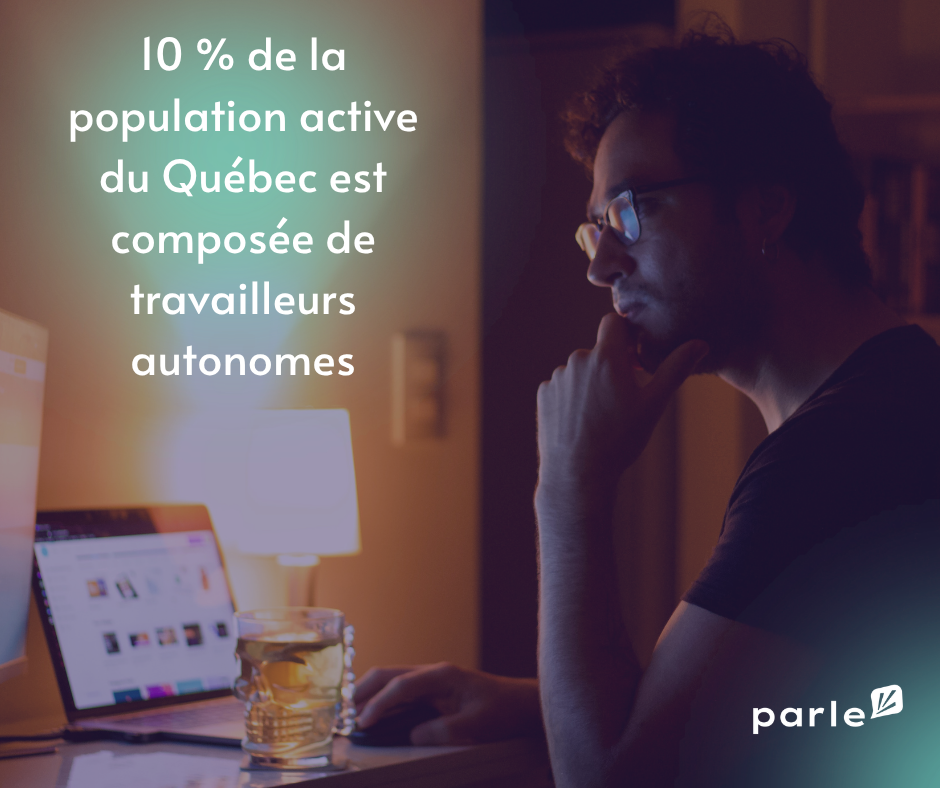
In 2024, approximately 499,700 people in Quebec were self-employed, representing almost 10.9% of the employed labour force, according to statistics compiled by Jérôme Lortie . This is not a marginal situation; it represents one in ten workers.
The difficulty is that self-employment is not merely a matter of paperwork. It depends on the reality of the working relationship. You can have a business number and send invoices yet still be considered an employee without source deductions.
If Revenu Québec reaches that conclusion, retroactive contributions for employment insurance, the QPP, and the QPIP may be due on both sides of the relationship. You are not the only one exposed: the company paying you can also face a hefty bill if it is treated as an employer that failed to make payroll deductions.
It is worth understanding how this test works, whether you invoice as a self-employed person or hire freelancers in your business.
The test: 3 basic criteria
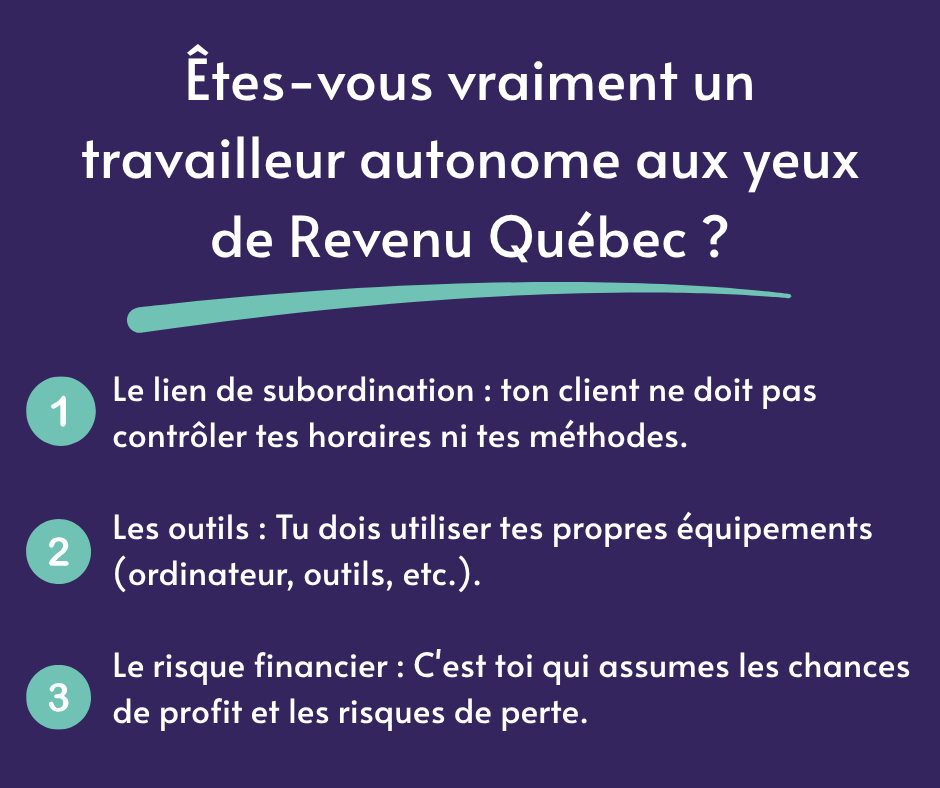
According to Lambert Avocats’ analysis , Revenu Québec uses several criteria to assess the true nature of a working relationship. The first three are often the most important.
The relationship of subordination. Does your client tell you when and how to work? A genuine client gives you a mandate and deadline. An employer gives you a schedule and dictates how the work is done. If you must sign in at 9 a.m., follow a prescribed process, and ask permission to take time off, the relationship looks much more like employment than self-employment.
Ownership of tools. Who provides the computer, software, and other tools? A self-employed person generally uses their own equipment. It may seem like a small detail, but it is one of the clearest signs that you operate your own business rather than being integrated into your client’s.
Financial risk. Can you profit from a project, or lose money when it takes longer than expected? An employee receives the same salary regardless of how efficiently the work is completed. A self-employed person assumes the financial consequences of their decisions. If they underestimate a project, they absorb the difference.
Other criteria to consider
The test does not stop there. Two other elements enter the equation.
Integration of the work. Do you perform a permanent, ongoing function in the client’s company, or complete a specific, defined mandate? If you effectively fill a role that would normally appear on the company’s organizational chart and do so continuously with no end date, that weighs in favour of employment.
The parties’ intent. What did both parties genuinely intend to create? A contract that refers to a “project,” “client,” and “supplier” sends a different signal from a verbal agreement about a “position,” “schedule,” and “direct supervisor.” No single word in a contract decides the issue. What matters is whether the language and behaviour on both sides tell the same story.
Bonus criterion: aim for a result, not time
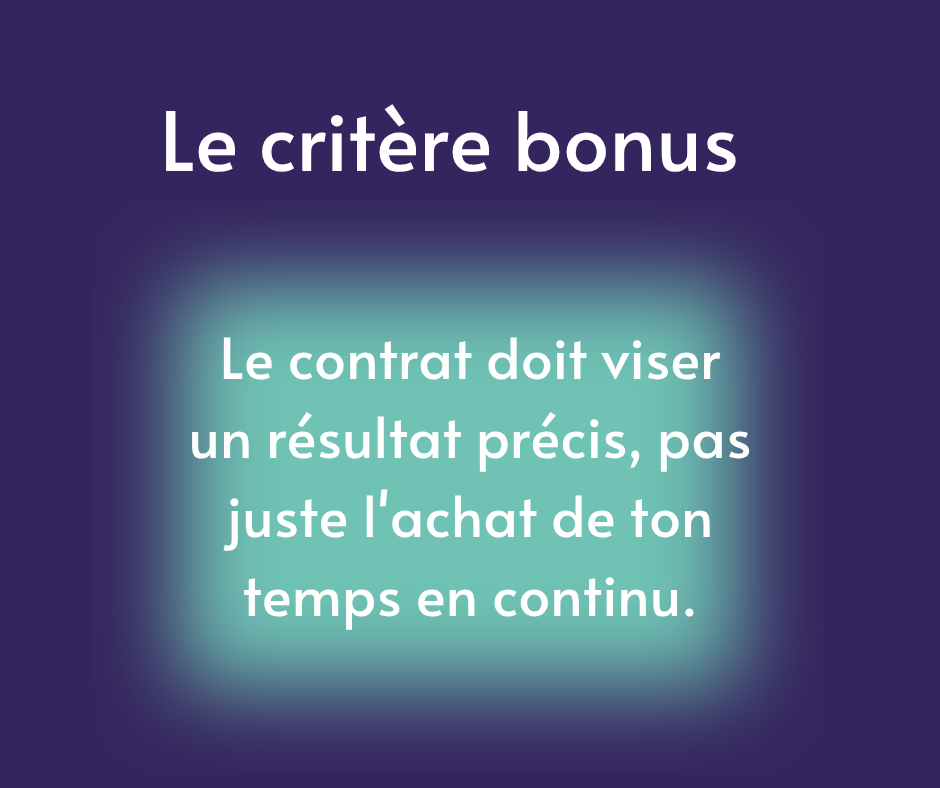
If one criterion captures the spirit of the test, it is this: your contract should cover the delivery of a specific result, not the ongoing purchase of your time.
“Rebuild the company’s website by August 15” describes a project.
“Be available 35 hours a week to do whatever I am asked” begins to look like employment, regardless of what appears on the invoice.
How to position yourself clearly as self-employed
The good news is that many of these criteria are within your control. A few habits can make a real difference:
- Have more than one client. This is not always possible, especially at the start, but depending on one payer is one of the strongest signals of a disguised employer-employee relationship.
- Use your own tools. Your computer, your software, your website, your billing system. What you own and operate yourself is part of the proof that you are operating your own business.
- Bill by project or deliverable. An hourly rate is not a problem in itself, but tying it to a specific project with a defined scope is very different from receiving a fixed weekly wage.
- Use a written proposal or contract that describes what you will deliver, not just when and for how many hours you will be available.
None of these elements guarantees your status on its own. Together, however, they paint the picture of a genuine small business, which is what Revenu Québec is trying to identify.
How this connects to Parle
That is part of why I built Parle.
When you manage contracts using your own website, proposals, and invoicing system instead of your client’s internal tools, you naturally meet several of the criteria discussed above: you own your tools, frame mandates through proposals that describe a result, and issue your own invoices rather than receiving payment through payroll.
This is not a legal shortcut. Your working relationship matters, not your software. But having professional tools of your own helps show clients and Revenu Québec what you genuinely operate: a business, not an untitled job.