
I was surprised to learn that the first problem people mentioned about the platforms they used before Parle was Quebec taxes. Their course or ecommerce platform either did not handle them at all or handled them poorly.
I expected Parle’s completely à la carte model to come up first. It turns out that is a close second.
The problem
Most platforms are designed in the United States. They either do not support Canadian taxes, much less Quebec taxes, or handle them so poorly that Canadian merchants cannot rely on them.
Honestly, that is not hard to believe. Parle does not manage taxes outside Canada, but we do not present ourselves as a global solution either. We handle Canadian taxes properly because we are a Canadian company.
Entrepreneurs work around this by not charging taxes, which is not recommended, or by including taxes in the item price. But if your business is based in Quebec and sells across Canada, buyers in Ontario and Quebec will not owe the same taxes.
That is the problem with these platforms: they do not understand how taxes work here.
If you include tax in your prices, you also have to do a great deal of manual work to prepare your quarterly tax remittances. That may be manageable at three sales a month, but at 10, 20, or 30 sales, you must consolidate every transaction and extract the correct amount based on each buyer’s address.
You need both skill and patience to keep doing that by hand.
Tax management in Parle
Parle is a platform for Canadian businesses. That is a deliberate choice. I like the “calm company” movement, but that is a topic for another post. Focusing on Canada means we can do things properly here.
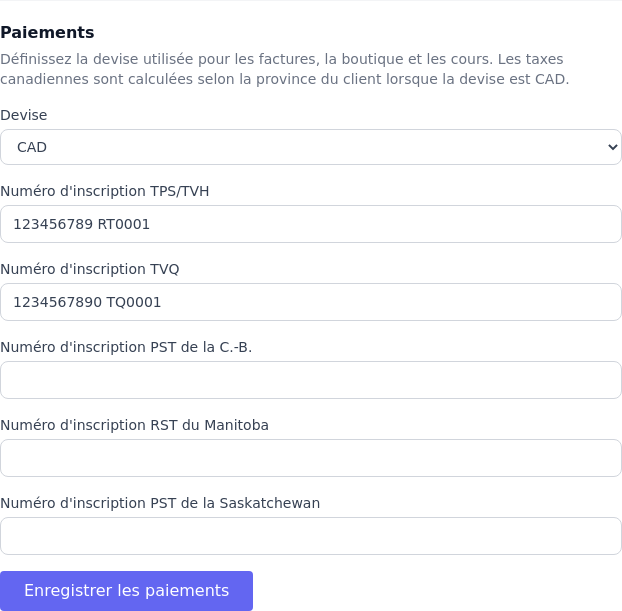
Simply enter your tax numbers in the payment settings. My company, Focus Centric Inc., has GST and QST numbers. Entering them automatically enables tax calculation.
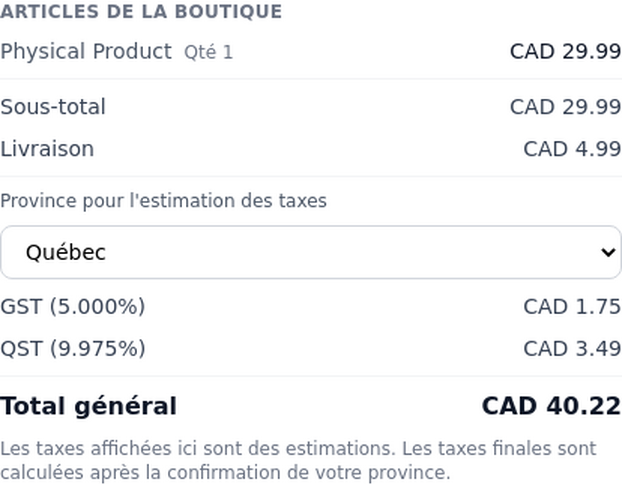
It does not stop there. When you make a sale with our shopping cart, including an order that combines several courses and store products, Parle calculates the correct tax amounts based on the buyer’s address.
If your business is in Quebec and you sell a product to someone in Ontario, that customer does not pay QST. The applicable tax is based on the province, so Ontario HST applies in this example. The same principle applies elsewhere in Canada: the buyer’s address matters.
Some provinces, such as British Columbia, can also have separate provincial tax rules depending on what you sell and your situation. That is precisely why your platform should not force you to manage everything by hand.
Government remittances
At this point, you may be thinking:
“Wow, that is quite a setup.”
We also made sure you have a simple, ready-to-use report for your quarterly government remittances, including your sales and the GST and QST amounts collected.
What can we say? We like it when our users are happy.
Tax management is only one part of Parle. The rest of the platform was also built around Canadian businesses, including Quebec businesses. We are based in Quebec too.
Running a business is already hard enough. Fighting with your platform should not be part of the job.