
In February 2026, I decided to pivot my Parle platform, which had been a customer communication platform along the lines of Intercom / Userlist, toward a platform to support Canadian small business owners with all the processes related to their business operations.
Between winding down the previous version and the alpha launch of the pivot, I had not renewed the parle.io domain name. I ended up taking one of the only domain names available that contained “parle” without a prefix or suffix – only parle.work was available.
The problem with non-.com / .ca domains
Inevitably, when a domain ends with an exotic TLD like .work, people assume the product or company name is Domain.Extension. So people were calling the platform “Parle dot Work,” when the product is simply “Parle.”
That is not the end of the world in itself, but the .work extension made things a bit more awkward.
First, it is not something you see very often. Even though uncommon extensions are becoming more visible – since there are almost no .com names left – people have not quite adapted to the idea that the extension is just the extension.
The downside is that when someone hears “parle dot work” or “parle work,” they do not necessarily associate it with the .work extension, so they have a harder time finding the site when they open their browser.
The alternative to unusual domains
The industry standard is to add a prefix or suffix that lets you secure the .com or .ca. This is a good technique, but the same problem exists: people will inevitably name your product or company with that prefix or suffix, at least until your brand is strong enough to be recognized on its own.
That is the trade-off I made. After running with parle.work for the alpha and soft launch, I decided to register a .ca with either a prefix or suffix. But which one? Everything seemed to sound off.
I wanted something that would work in both French and English, since Parle is a platform for Canadian businesses – a name that sounds natural in both languages would be ideal.
The objective was clear: something rooted in Quebec, rooted in Canada. A domain that would better reflect what Parle is – an all-in-one platform built for SMEs and solopreneurs here.
The choice of onparle.ca felt obvious. In French, “on parle” evokes conversation, exchange, community. In English, “on Parle” can read as “on Parle” – you are running on Parle. A double meaning I found elegant. I registered the domain without much hesitation.
That is when things started to get interesting.
Google Search Console had some surprises in store
A few days after configuring the new domain, I took a look at Google Search Console. Three issues caught my attention.
Duplicate without user-selected canonical. The first was classic and entirely my fault: no <link rel="canonical"> tag in the site template. Google had visited both https://onparle.ca/ and https://www.onparle.ca/ and, without a canonical directive, did not know which version to prefer. Simple fix: one line in the template.
Not found (404) with a… colourful URL. The second one initially threw me off. A URL under my domain, containing very vulgar French words, was returning a 404 error. After some thought, this is a common phenomenon: spam networks create links pointing to bogus URLs on legitimate domains, often combining a city name with keywords from adult sites. The URL never existed on my server. Google crawled it from an external site, got a 404, and reported it. No real impact, but it is unsettling to see that under your own domain.
Crawled - currently not indexed with a strange subdomain. The third was more revealing: https://[random-subdomain].onparle.ca/?[parameter]=238, crawled in February 2024 – before I even registered the domain. A random subdomain with a nonsensical parameter. Classic infrastructure for a redirect or spam setup.
That last point pushed me to investigate what had actually happened on this domain before I owned it.
The investigation in the Wayback Machine
The Wayback Machine archives snapshots of websites going back to the 1990s. You can search any domain and see what it hosted in the past.
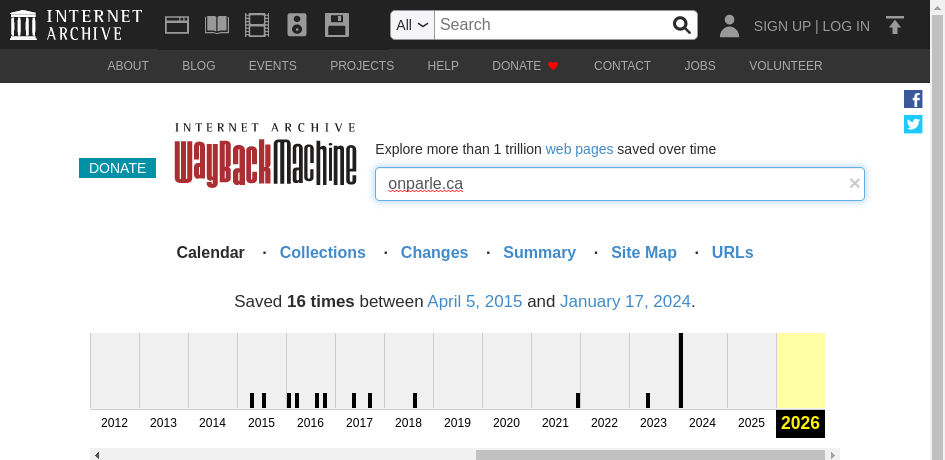
For onparle.ca, here is what I found:
- 2015: the domain redirected to
onparleargent.ca– “on parle argent,” clearly a personal finance discussion site. Nothing problematic. - January 2024: the domain redirected to
reddit.com. This is a typical sign of an expired domain bought by a squatter or parking service, which redirects it to a high-traffic site while waiting to resell it or use it. - February 2024: the random subdomain is crawled. Probably linked to this squatting period.
In the end, the domain was not used for years of spam or problematic content. The questionable period was brief – a few weeks or months between the original domain’s expiry and my registration. This is a situation Google understands well and should not leave lasting marks once the new content establishes itself.
The takeaway
Checking a domain’s history before buying it is a step almost never mentioned in website creation guides. Yet a domain can carry a reputation with Google – spam penalties, toxic backlinks, indexed adult content – that can complicate SEO work for months.
The check takes five minutes:
- Go to web.archive.org and search the domain.
- Look at the first and last available snapshots.
- In Google Search Console, check the “Pages” and “Links” reports to see what already exists under the domain.
- If toxic links appear, use the GSC Disavow tool to distance yourself from them.
In my case, the story had a happy ending. But if onparle.ca had spent three years as a spam or adult content site, I would have inherited a much more serious problem – and I would probably have had to choose a different name.
The bilingual wordplay was worth checking out. Fortunately, it held up.